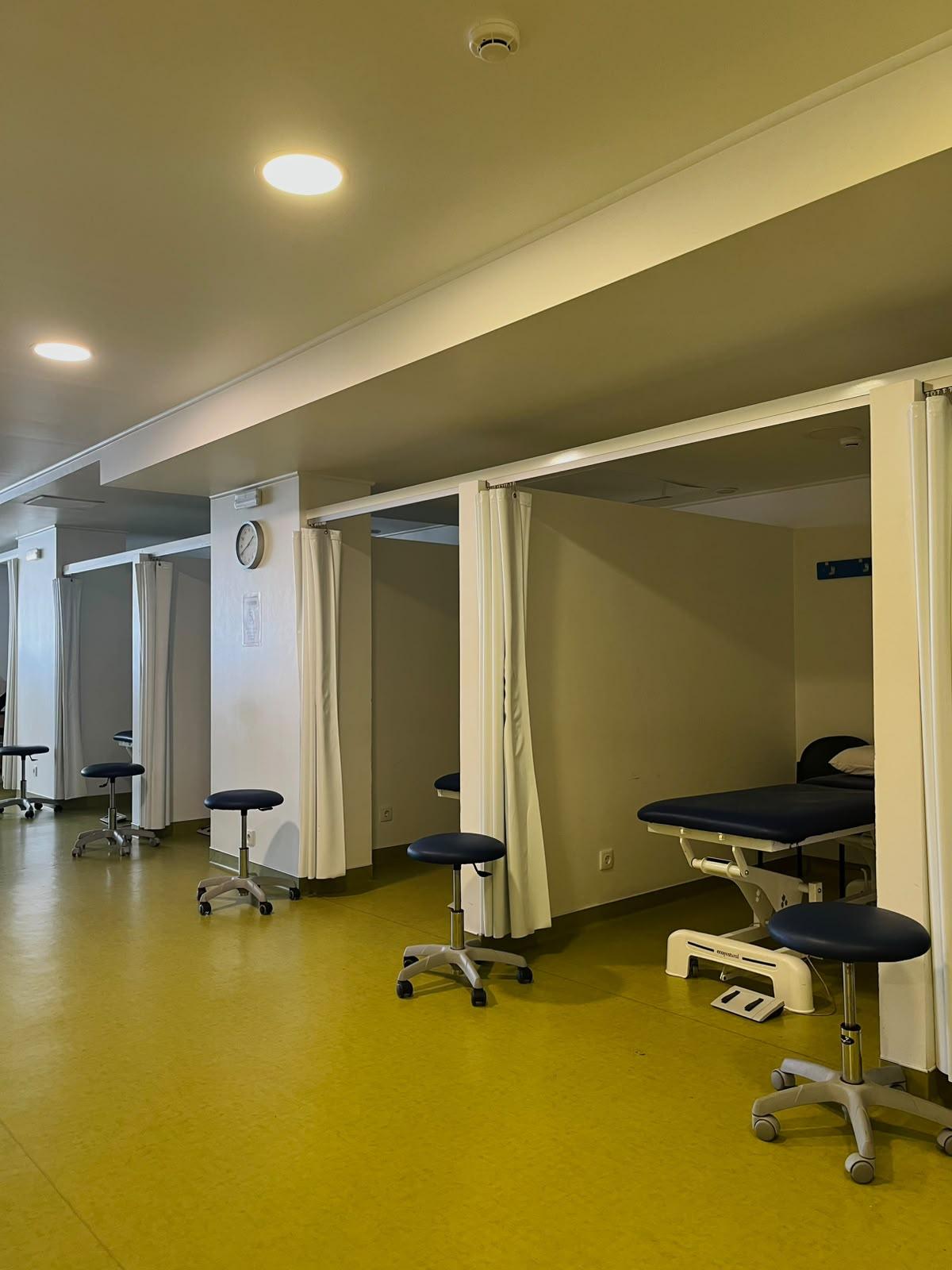
Physiotherapy: price, number of sessions and first appointment
Price ranges along the Cascais coast, guidance on the number of sessions, and what to expect, and bring, at your first appointment.
Answers with figures and public sources, to help you decide. They are no substitute for an appointment: if you have a specific concern, speak to a health professional.
How much does a physiotherapy session cost on the Cascais line?
Short answer. On the Cascais line and in Lisbon, a private physiotherapy session usually costs between €45 and €60, and the first assessment between €50 and €65. Packages of 5 or 10 sessions bring the price down to around €39 to €50 per session (see what makes the price vary). As a rule, the invoice counts towards IRS (Portuguese income tax) health expenses, with a 15% deduction. To find out the price at Clínica de Exercício, call 21 828 4467 (call to a national landline).
Market prices on the Cascais line and in Lisbon
From public price lists of clinics and physiotherapists on the Cascais line and in Lisbon, checked in November 2026:
- first assessment: €50 to €65;
- follow-up session: €45 to €60;
- packages of 5 or 10 sessions: around €39 to €50 per session;
- home visits, in the municipality of Cascais: €55 to €60 per session.
Quote platforms show lower figures (a median of €30 in Cascais, with a range of €28 to €54), because they mix independent practitioners and shorter sessions.
What makes the price vary
- the length of the session: 30, 45 or 60 minutes;
- whether the physiotherapist is with you alone for the whole session;
- the area: pelvic physiotherapy, for example, usually costs €50 to €60 per session (see pelvic physiotherapy);
- home visits.
How to pay less
- session packages;
- keep the invoice with your tax number (NIF): physiotherapy is VAT-exempt and counts towards IRS health expenses (15%, up to €1000 per household) when the invoice is from a healthcare provider;
- with ADSE (civil service health scheme) or insurance, check beforehand which documents are needed (see ADSE and insurance);
- on the SNS (Portugal's National Health Service), physiotherapy is free (outside A&E there have been no user charges since 2022), but there is a wait and it requires a medical referral.
To find out the price at Clínica de Exercício, call 21 828 4467 (call to a national landline).
How many sessions will I need, and how many per week?
Short answer. The number is decided after the assessment, but there are benchmarks: a simple recent injury often resolves in 3 to 6 sessions, chronic pain calls for 8 to 12 weeks of work and recovery after surgery can take several months. At the start, 1 to 2 sessions a week is common. Home exercises are part of the treatment; we have gathered the benchmarks by type of problem.
What the sources say
The English health service (NHS) does not set a number: it is the physiotherapist who advises how many sessions are needed, and home exercises «are important». In the patient accounts collected by the University of Oxford, the most common pattern is one session a week for 6 to 10 weeks.
Benchmarks by type of problem
- Chronic low back pain, with Pilates or exercise: 2 to 3 sessions a week for 8 to 12 weeks (see clinical Pilates).
- Pelvic floor training: at least 3 months (see pelvic physiotherapy).
- Vestibular rehabilitation: 4 to 9 weeks of daily exercises, with one appointment a week (see dizziness and vertigo).
- RPG: in studies, around 15 weekly sessions (see RPG).
- Pulmonary rehabilitation in COPD: 6 to 8 weeks.
With ADSE, the limit is 90 treatments of each type per calendar year, with a renewed prescription.
When to review the plan
It is worth talking to your physiotherapist if there is no improvement at all after 4 to 6 sessions, if there is no plan with goals, or if the sessions are purely passive, with machines and no exercise.
What happens at the first physiotherapy appointment and what should I bring?
Short answer. As a rule, the first appointment is an assessment: the physiotherapist asks what you are feeling, since when and what you want to get back to doing, looks at your posture, movement, strength and balance, and proposes a plan with the expected number of sessions. Treatment often starts straight away. Bring scans, reports and your list of medication, and wear comfortable clothing that allows the area to be treated to be seen (see the step by step).
Step by step
- questions about your symptoms, history and lifestyle;
- examination of the affected area, strength and balance;
- an explanation of the findings and the proposed treatment, with the expected number of sessions;
- exercises to do at home.
How long it lasts
In the Scottish health service (NHS Tayside), the first physiotherapy appointment lasts around 45 minutes. In private practice on the Cascais line, public price lists show 30-minute assessments and 50 to 60-minute sessions.
What to bring
- scans (X-ray, ultrasound, MRI) and reports;
- your discharge summary, if you have had surgery;
- your list of medication;
- your prescription, if you have one and want to claim reimbursement from ADSE or your insurer.
What to wear
Loose clothing that allows the area to be treated to be seen: shorts for the knee or hip, a vest top for the shoulder or back.
At Clínica de Exercício, the biomechanical assessment (plantar pressures, running analysis and dynamometry) is a separate test, which may make sense after the physiotherapy assessment (see what it is for).
Sources
- NHS — Physiotherapy
- NHS Tayside — Physiotherapy
- University of Oxford (Healthtalk) — patients' experiences of physiotherapy
- Portal das Finanças — artigo 78.º-C do CIRS (IRS Code, article 78-C: health expenses)
- ADSE — Tabela de preços e regras do regime livre (free-choice scheme price table and rules)
At Clínica de Exercício
These answers are summarised on the physiotherapy and clinical Pilates in Estoril and physiotherapy in Estoril pages. To book, ask about prices or with any questions, call 21 828 4467 (call to a national landline). See all the frequently asked questions or go back to the home page.