Physiotherapy and clinical Pilates in Estoril

Specialist assessment and treatment — from the musculoskeletal system to the pelvic floor, balance and breathing, with Clinical Pilates to consolidate recovery.

Clínica de Exercício is on Av. Fausto de Figueiredo, in Estoril, and brings a physiotherapy department and an exercise department together under one roof. The physiotherapy team has 11 physiotherapists, coordinated by Matilde Machado. Each has their own areas of training, which you can see on the team page.

If you come to us in pain, after an injury or with a limitation that will not go away, you want to know what is wrong and what you can do about it. The answer starts with an assessment. That leads to the plan: therapeutic techniques, tailored exercise and, when recovery allows, moving on to Clinical Pilates or training with the exercise team.

Below are the seven services in this area. Each has its own page, covering what it is, who it is for and what to expect.

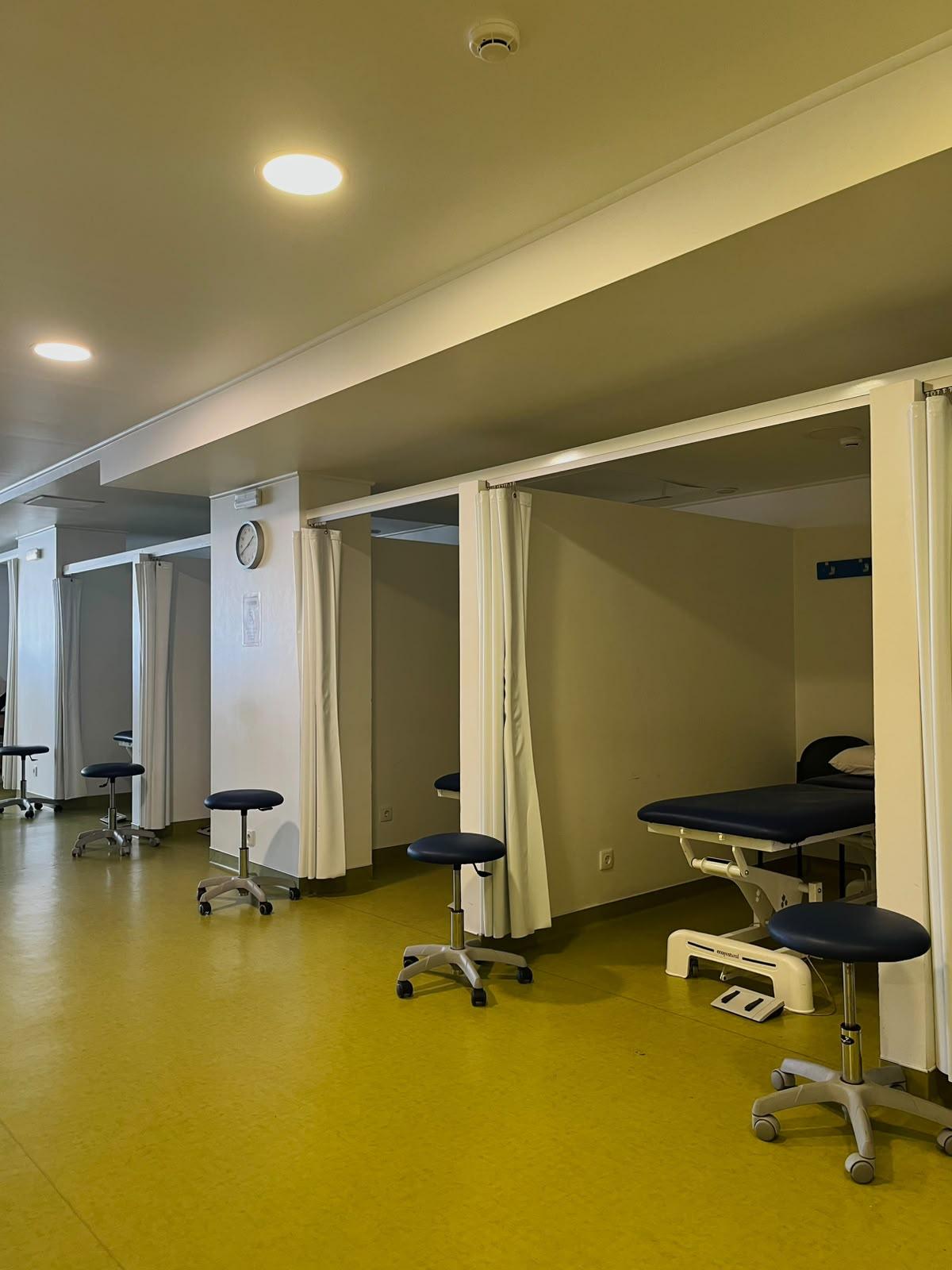
Treatment room with couches separated by curtains

Physiotherapy

Physiotherapy treats problems with movement and physical function: back or neck pain, sprains, stiffness after an injury. It combines therapeutic techniques with exercises tailored to each person, to relieve pain, restore mobility and get back to your routine. It also helps with prevention: understanding what is overloading a joint before it becomes an injury. Find out how physiotherapy in Estoril works at Clínica de Exercício.

Learn more

Pelvic Physiotherapy — Women’s Health

Pelvic physiotherapy works on the pelvic floor and abdominopelvic function. In women’s health, it supports stages such as pregnancy, the postnatal period and the menopause. It helps improve muscle strength and coordination, gain bladder control and relieve pain. It always begins with an individual assessment. Read more about pelvic physiotherapy in Estoril.

Learn more

Respiratory Physiotherapy

Respiratory physiotherapy prevents and treats problems of the respiratory system. It uses specific techniques and breathing exercises to improve ventilation, help loosen and clear secretions, reduce breathlessness and increase exercise tolerance. It can be useful in chronic respiratory diseases or when recovering from a respiratory infection. See the respiratory physiotherapy in Estoril page.

Learn more

Vestibular Rehabilitation

Dizziness, vertigo and imbalance can come from the vestibular system, in the inner ear. Vestibular rehabilitation uses individualised balance, gaze stabilisation and movement adaptation exercises to reduce symptoms and restore confidence in everyday life. In our team, Jully Moura counts vestibular rehabilitation among her specialities. More on the vestibular rehabilitation in Estoril page.

Learn more

TMJ — Temporomandibular Joint

The temporomandibular joint (TMJ) connects the jaw to the skull. When there is pain, clicking or difficulty opening the mouth, TMJ physiotherapy assesses the joint and the surrounding muscles. With specific techniques and therapeutic exercises, it aims to relieve pain, improve jaw mobility and make chewing, speaking and yawning easier. Liliane Toga has training in this area. Learn more about TMJ physiotherapy in Estoril.

Learn more

RPG — Global Postural Re-education

Global Postural Reeducation (RPG) works on posture through specific postures and progressive stretching. It is used for postural problems and some musculoskeletal conditions, to improve mobility and muscle balance and reduce pain. In our team, Rafael Costa and Liliane Toga are trained in RPG using Philippe Souchard’s method. See how RPG in Estoril works.

Learn more

Clinical Pilates

Clinical Pilates is exercise adapted to each person’s needs and abilities, focusing on motor control, stability and quality of movement. It is used to prevent and rehabilitate musculoskeletal dysfunctions and helps consolidate recovery. It is not the same as the Pilates offered by the exercise department. The clinic has a Clinical Pilates studio with equipment. Discover clinical Pilates in Estoril.

Learn more

Frequently asked questions

Short answers, with numbers and sources. There is more in all frequently asked questions.

Can I book physiotherapy without a doctor’s referral?

Yes. In the private sector in Portugal, you can book directly with a physiotherapist, who carries out their own assessment: since Portaria n.º 88/2024/1, physiotherapy units exist as independent establishments. A referral is only needed to have physiotherapy through the SNS (Portugal’s National Health Service) or claim reimbursement from ADSE or your insurer. Tests are not required, but if you have any, bring them.

How much does a physiotherapy session cost on the Cascais Line?

On the Cascais Line and in Lisbon, a private physiotherapy session usually costs between €45 and €60, and the first assessment between €50 and €65. Packages of 5 or 10 sessions bring the price down to around €39 to €50 per session (see what makes the price vary). As a rule, the invoice counts as a health expense for IRS (Portuguese income tax), with a 15% deduction. To find out the price at Clínica de Exercício, call 21 828 4467 (call to a national landline).

How many sessions will I need, and how many per week?

The number is decided after the assessment, but there are benchmarks: a simple recent injury often resolves in 3 to 6 sessions, chronic pain calls for 8 to 12 weeks of work and recovery after surgery can take several months. At the start, 1 to 2 sessions a week is common. Home exercises are part of the treatment; we have gathered the benchmarks by type of problem.

Do ADSE or health insurance pay part of physiotherapy?

They can, but there are rules. Under the ADSE (civil service health scheme) agreement scheme you pay only the co-payment, at a provider with an agreement; under the free scheme you pay everything and claim reimbursement within 6 months, with a medical prescription, an invoice showing the type and number of treatments and a copy of the physiotherapist’s professional licence. With insurers, it depends on whether you use a network provider or claim reimbursement. See the documents ADSE and insurers ask for and, to find out what Clínica de Exercício issues, call 21 828 4467 (call to a national landline).

What happens at the first physiotherapy appointment and what should I bring?

As a rule, the first appointment is an assessment: the physiotherapist asks what you feel, since when and what you want to get back to doing, observes your posture, movement, strength and balance, and proposes a plan with the expected number of sessions. Treatment often starts straight away. Bring any tests, reports and your list of medication, and wear comfortable clothing that allows the area to be treated to be seen (see the step-by-step guide).

Ready to take the first step?